
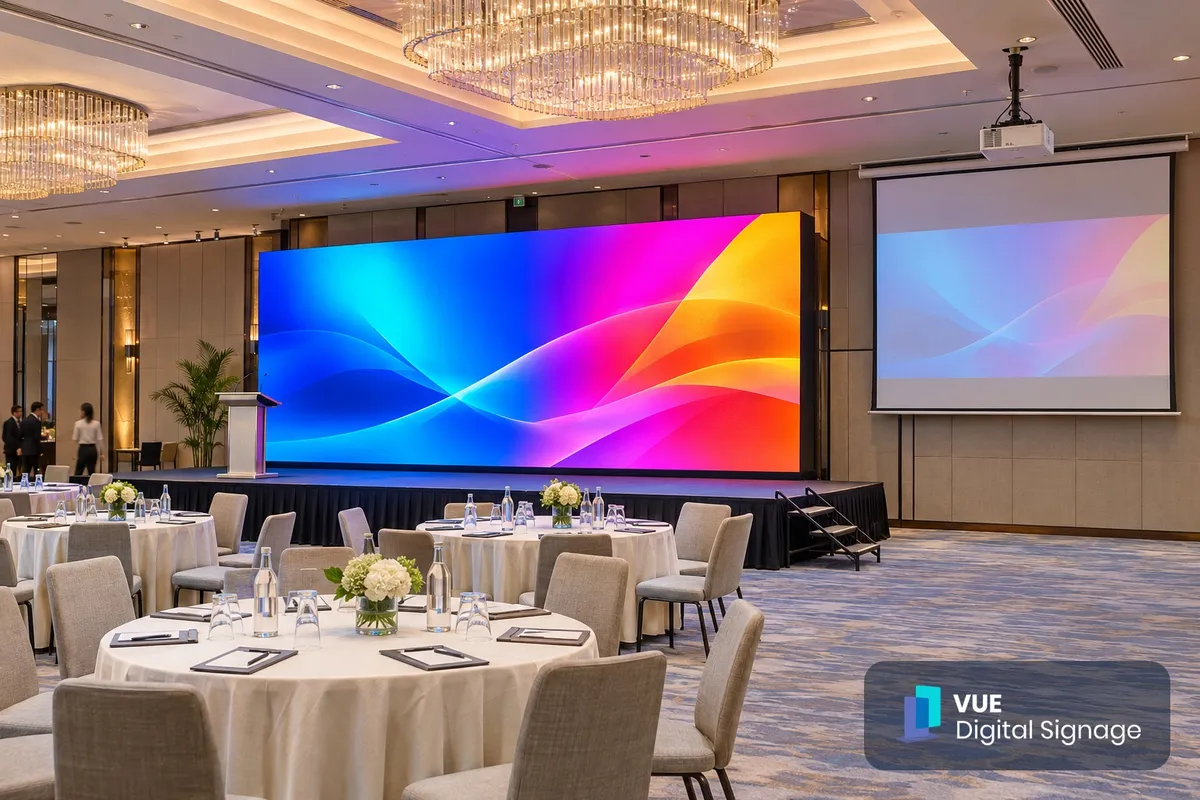
For most Singapore events, an LED wall is the better choice when the room is lit, the event runs in daytime or the screen is outdoors, because it makes its own light and stays bright at any size. A projector is the better choice for a large image in a dark, controlled room on a tight budget. Room light decides it more than anything else.
This guide compares the two on brightness, image size, set-up, rigging and cost, using manufacturer specs and the standard lumens-to-nits conversion, so you can brief your venue or AV supplier. It is written for event organisers, corporate communications teams and venue managers planning conferences, launches, gala dinners and exhibitions. If you are choosing a display for a classroom rather than a stage, read our interactive flat panel vs projector guide instead.
Key takeaways
- An LED wall emits light; a projector reflects light off a screen. Room light lowers a projector's contrast; it affects an LED wall far less.
- On a 5 x 3 m screen, a 10,000-lumen projector gives about 212 nits in ideal conditions. Hikvision's Aries indoor rental LED cabinets are rated at 1,000 nits.
- Matching 1,000 nits on that screen would take about 47,000 projector lumens.
- Projectors need throw distance and a clear light path; LED walls need a solid base or rigging, power and set-up time.
- Projectors usually cost less for very large images in dark rooms. LED walls win in ballrooms with house lights on, atriums, daytime and outdoor events.
What is the difference between an LED wall and a projector?
An LED wall (also called an LED screen or LED video wall) is a screen built from LED cabinets, each one covered in red, green and blue LEDs that produce the image directly. A projector shines light through a lens onto a separate screen, and the audience sees the light that bounces back. That one difference explains most of what follows: an LED wall's brightness is fixed by the panel, while a projector's brightness is spread across the screen and competes with every other light in the room.
LED walls are modular. Vue's Hikvision rental cabinets, for example, come in 500 x 500 mm and 500 x 1000 mm sizes that lock together into walls of almost any size, and the Aries cabinets have a curve lock of up to plus or minus 10 degrees. Projectors are single units; a bigger image means either a brighter projector or a dimmer picture.
Which is brighter, an LED wall or a projector?
An LED wall is much brighter on a large screen. Indoor rental LED cabinets are rated in the hundreds to thousands of nits (Hikvision's Aries indoor rental cabinets: 1,000 nits), while a 10,000-lumen projector spread over a 5 x 3 m screen delivers only about 212 nits, and less in practice.
The two use different units, which is why spec sheets are hard to compare. LED walls are rated in nits (candelas per square metre), the brightness you see on the surface. Projectors are rated in lumens, the total light leaving the lens. To convert, ProjectorCentral gives screen brightness in foot-lamberts as lumens x screen gain / screen area in square feet, and one foot-lambert is about 3.43 nits. In metric terms that works out to roughly lumens x gain / (3.14 x area in square metres).
Here is what that gives for a 5 x 3 m image (15 m2, an example ballroom stage screen) on a standard gain 1.0 screen. These are best-case figures: lens settings, an older light source and a darker screen surface all reduce them.
| Display on a 5 x 3 m screen | Rated output | Brightness on screen |
|---|---|---|
| Meeting-room projector | 5,000 lumens | about 106 nits |
| Event projector | 10,000 lumens | about 212 nits |
| Large-venue laser projector (e.g. Epson EB-PU2120W) | 20,000 lumens | about 424 nits |
| Indoor rental LED wall (Hikvision Aries, P1.9 to P2.9) | 1,000 nits | 1,000 nits |
| Outdoor rental LED wall (Hikvision P3.9) | 4,500 nits | 4,500 nits |
To reach 1,000 nits on that same screen, a projector would need about 47,000 lumens; to reach 600 nits, the rating of Hikvision's fixed indoor LED panels, about 28,000 lumens. That is why large projected images are kept for darkened rooms.
Not sure whether your venue is too bright for a projector? Send us the room, screen size and lighting and we will work out the brightness you need and quote an LED wall to match.
How does room lighting affect a projector?
Room light lands on the projection screen too, so it lifts the blacks and washes out the picture. A projector's black can never be darker than the screen under the room lights. An LED wall is a dark surface that emits its own light, so ambient light hurts it far less.
ProjectorCentral's guide shows how much the target changes with light. It cites a common recommendation of 16 foot-lamberts (about 55 nits) for a dark room, about 50 foot-lamberts (about 171 nits) for a family room with some ambient light, and at least 60 foot-lamberts (about 206 nits) for bright content in daytime. Commercial venues are brighter still.
In Singapore events, these are the situations where light usually decides it:
- Hotel ballrooms during dinner or networking: house lights and stage lighting stay on so guests can see each other and be filmed. An LED wall keeps the slides readable.
- Atriums, malls and lobbies: skylights and glass make blackout impossible. LED is usually the only option that stays visible at midday.
- Outdoor events: projectors generally only work outdoors after dark. An outdoor LED cabinet with a high brightness and IP65 rating, like Hikvision's P3.9 rental cabinet at 4,500 nits, can run in daylight and rain.
- Seminars and screenings in a darkened room: a projector can look excellent here and costs less.
LED wall vs projector: side-by-side comparison
| Factor | LED wall | Projector |
|---|---|---|
| How the image is made | Emits light from LEDs | Reflects light off a screen |
| Lit rooms and daylight | Stays bright and contrasty | Washes out unless very high lumens |
| Image size | Any size in 0.5 m steps; cost grows with area | Very large images possible; brightness falls as size grows |
| Resolution | Set by pitch and wall size (P2.6 at 5 x 3 m = 1920 x 1152) | Set by the projector (e.g. 1920 x 1200, 4K) |
| Space needed | About 69 mm cabinet depth plus frame or rigging | Throw distance in front (or behind, for rear projection) |
| Shadows | None; presenters can stand in front | Front projection casts shadows on anyone in the beam |
| On camera | High refresh (7,680 Hz on Hikvision Aries indoor rental cabinets) suits filming | Depends on room light and the screen surface |
| Weight and power | Heavier; needs load and power planning | Light; one power point |
| Typical cost | Higher per square metre | Lower, especially for large images in dark rooms |
How much space and set-up does each need?
A projector needs a clear path to the screen. Its throw ratio (distance divided by image width) sets where it must sit: a lens with a throw ratio of 1.5 has to be 7.5 m back to fill a 5 m wide screen, and anyone who walks through the beam casts a shadow. Short-throw lenses or rear projection solve this but add cost and need space behind the screen.
An LED wall stands or hangs where the image goes, so it suits shallow stages and rooms where a projector cannot be placed. The trade-off is weight and set-up. A 5 x 3 m wall of Hikvision's 500 x 500 mm P2.6 indoor rental cabinets uses 60 cabinets at under 7.1 kg each, up to about 426 kg before frames or hanging beams. Ask the venue about floor loading or rigging points, power and the load-in window. Hikvision says each cabinet's components can be assembled, disassembled and maintained within 5 seconds, which helps technicians fix a fault quickly during a show.
Which pixel pitch do you need for an event LED wall?
Pick the pitch from the closest audience row: roughly 2.5 to 3 m of viewing distance per millimetre of pitch looks smooth (Samsung's rule works out to about 2.4 m per mm and Christie's chart to about 3 m). For a ballroom where the front tables are 5 to 8 m from the stage, P1.9 to P2.6 is a good fit; for large stages and outdoor screens viewed from 10 m or more, P2.9 to P3.9 is common. Our LED wall pixel pitch guide explains the rules in detail.
The Hikvision rental cabinets in Vue's catalogue are a useful reference:
| Cabinet | Pitch | Size and pixels | Brightness / protection | Good for |
|---|---|---|---|---|
| DS-D4619CD-1AC/P | 1.95 mm (P1.9) | 500 x 500 mm, 256 x 256 | 1,000 nits, IP40 (indoor) | Conferences and launches with close front rows |
| DS-D4626CD-1AC | 2.60 mm (P2.6) | 500 x 500 mm, 192 x 192 | 1,000 nits, IP40 (indoor) | Ballrooms and gala dinners |
| DS-D4629CF-1AC | 2.98 mm (P2.9) | 500 x 1000 mm, 168 x 336 | 1,000 nits, IP40 (indoor) | Large stages and exhibition backdrops |
| DS-D4739CF-1AC | 3.91 mm (P3.9) | 500 x 1000 mm, 128 x 256 | 4,500 nits, IP65 (outdoor) | Outdoor and daylight events |
Specs are from the Hikvision Pro AV product pages (linked here for the P2.6) and Vue's catalogue. The three indoor Aries cabinets list a 7,680 Hz refresh rate, a contrast ratio of at least 6,000:1 and a 160-degree horizontal (140-degree vertical) viewing angle; the outdoor P3.9 is rated at 4,500 nits and IP65.
LED wall vs projector cost: what to compare in quotes
Usually yes, especially for very large images in rooms you can darken: one projector and screen cost less than a wall of LED cabinets, a processor and a crew to build it. But price only makes sense if the audience can see the content. If the venue keeps its lights on, the cheaper option may fail the brief.
Compare like for like when you collect quotes:
- The same image size and the same content (slides with small text need more resolution than video).
- Everything included: screen or cabinets, processor or switcher, stand or rigging, cabling, delivery, set-up, an on-site technician and tear-down.
- Set-up time against the venue's load-in window, and whether rehearsal time is included.
- For projectors, the lumen rating at the lens setting used and the projector's age, since light output falls over the light source's life. Epson, for example, rates its laser projectors at up to 20,000 hours of estimated life in Normal Mode.
When should you choose a projector instead?
Choose a projector when the room can be darkened, the image needs to be very large, the budget is tight, or you want to project onto an unusual surface such as a building or set piece (projection mapping). For small meetings and training rooms, a projector or an interactive flat panel is simpler than an LED wall; our interactive flat panel vs projector guide compares the two.
Choose an LED wall when the lights stay on, the event runs in daytime or outdoors, presenters walk in front of the screen, the event is filmed or livestreamed, or the stage is too shallow for a projector's throw distance.
Renting an LED wall for an event in Singapore
Vue Digital Signage offers LED video wall rental in Singapore for conferences, product launches, gala dinners and exhibitions, and supplies permanent LED video walls for lobbies and venues. Send us the venue, the screen size you have in mind, the distance to the front row and whether the event is indoors or outdoors, and we will recommend a pitch and quote. Contact the team or message us on WhatsApp.
Frequently asked questions
Is an LED wall better than a projector for events?
In a room with the lights on, daylight or outdoor sun, yes: an LED wall makes its own light, so it stays bright and contrasty. In a dark, controlled room with a big screen and a tight budget, a projector can still give a good picture for less money.
How many lumens do I need to compete with an LED wall?
On a 5 x 3 m screen with a gain of 1.0, a projector needs about 47,000 lumens to reach the 1,000 nits of an indoor rental LED cabinet, and about 28,000 lumens to reach 600 nits. A 10,000-lumen projector gives about 212 nits on that screen in ideal conditions.
What pixel pitch should I rent for an event LED wall?
Match the pitch to the closest audience row. P1.9 to P2.6 suits ballrooms and conferences where the front row is 5 to 8 m away; P2.9 to P3.9 suits larger stages and outdoor screens viewed from further back.
Can an LED wall be used outdoors in Singapore?
Yes, if it is an outdoor cabinet. Hikvision's outdoor rental P3.9 cabinet sold by Vue is rated at 4,500 cd/m2 and IP65, while its indoor rental cabinets are 1,000 cd/m2 and IP40, which is for indoor use only.
Is a projector cheaper than an LED wall?
Usually, especially for very large images in dark rooms. But if the venue is bright, a cheap projector that the audience cannot see well is not a saving. Compare quotes for the same screen size and ask what each includes: rigging, processor, operator and set-up time.